
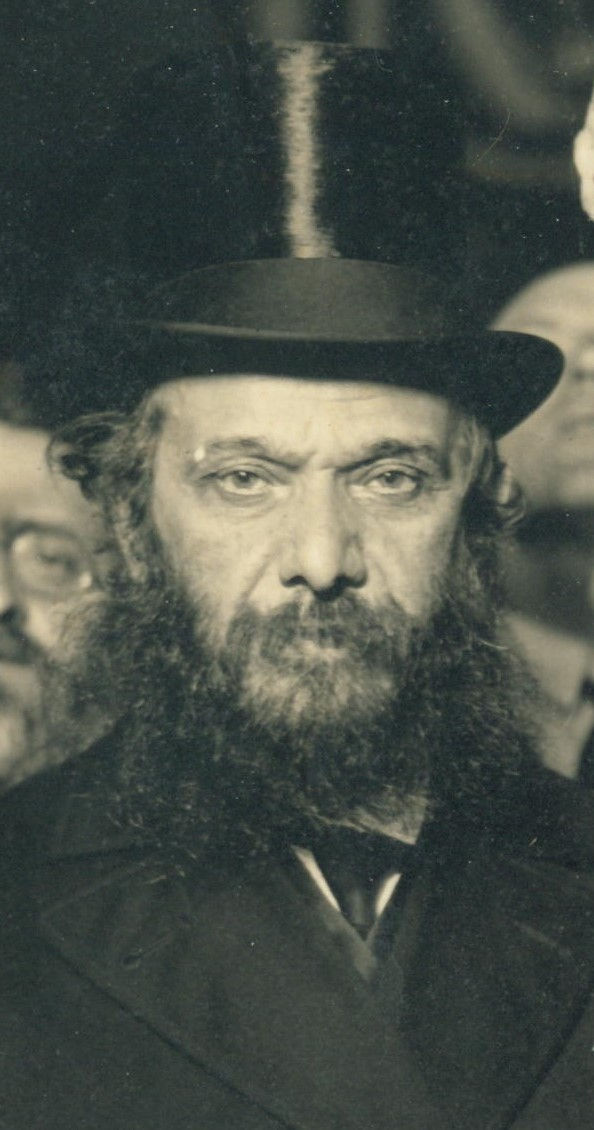
Grave of Rabbi Moshe Mordechai Epstein
Rabbi Moshe Mordechai Epstein (1866 – November 29, 1933) was one of the premier Lithuanian Roshei Yeshiva (yeshiva heads), halachic authorities, and Talmudic analysts of the late 19th and early 20th centuries.
Alongside his brother-in-law, Rabbi Isser Zalman Meltzer, and the legendary Alter of Slabodka (Rabbi Nosson Tzvi Finkel), Rav Moshe Mordechai built the Slabodka Yeshiva into an unparalleled, elite powerhouse of Torah study. He is immortalized as a foundational architect of the Hebron Yeshiva in Mandatory Palestine, steering his community through the horrific 1929 Hebron Massacre and successfully transplanting the crown of Lithuanian scholarship into the Land of Israel.
The Illui of Bakst
Early Genius: Born in Bakst (Bakshty), Belarus, Moshe Mordechai was quickly identified as an Illui (a rare child prodigy). He possessed a blindingly fast, fiercely creative intellect and a photographic memory.
The Volozhin Matrix: As a teenager, he went to study at the premier Volozhin Yeshiva, the mother of all Lithuanian yeshivas. There, he became a prized disciple of the monumental Netziv (Rabbi Naftali Zvi Yehuda Berlin) and the legendary Rabbi Chaim Soloveitchik (the founder of the abstract Brisker method of analysis).
The Dynamic Match: In 1892, his immense scholarship caught the attention of the Alter of Slabodka. He married Chaya Gershon, the daughter of a wealthy patron of the Slabodka Yeshiva. Shortly thereafter, his brother-in-law, Rabbi Isser Zalman Meltzer, married Chaya's sister, uniting two of the greatest minds of the generation into a single family.
Leading the Slabodka Empire
In 1894, at the remarkably young age of 28, Rav Moshe Mordechai was appointed the premier Rosh Yeshivaof the Slabodka Yeshiva (Yeshivas Knesseth Yisrael) in suburban Kovno, Lithuania.
While the Alter of Slabodka managed the spiritual character development (Mussar) and psychological growth of the students, Rav Moshe Mordechai was the absolute master of the intellect.
The Methodology of Clarity: His lectures (shiurim) were legendary for their structural elegance and conceptual brilliance. He rejected overly convoluted, forced intellectual gymnastics (pilpul) in favor of a profound, streamlined clarity that extracted the exact legal blueprint of the Talmudic text.
Cultivating Giants: Under his direct tutelage, Slabodka produced the elite leadership cadre that would eventually define 20th-century Orthodoxy, including Rabbi Yitzchok Hutner, Rabbi Yaakov Kamenetsky, Rabbi Aharon Kotler, and his own nephew, Rabbi Yechezkel Sarna.
Moving the Crown to Hebron
Following World War I, changes in Lithuanian law regarding military conscription threatened the survival of the yeshiva and its students. In 1924, Rav Moshe Mordechai made a historic, daring decision: he would move the elite core of the Slabodka Yeshiva to the ancient city of Hebron in Mandatory Palestine.
The move was a spectacular success. Over 150 European students packed their bags and relocated to the Judean hills, establishing the Hebron Yeshiva (Knesseth Yisrael). Rav Moshe Mordechai transformed the ancient, sleepy city into a vibrant center of elite, European-style Lithuanian scholarship, harmonizing the ancient past with cutting-edge intellectual realism.
The 1929 Hebron Massacre: A Broken Heart
The apex of tragedy struck on August 24, 1929, when local Arab rioters initiated a brutal, systematic pogrom against the Jewish residents of Hebron.
The Devastation: The rioters stormed Jewish homes and yeshiva dormitories. While some Arab neighbors protected certain students, 24 yeshiva students—the absolute flower of European and American Torah scholarship—were brutally murdered, and dozens more were severely mutilated.
The Shield of the Rosh Yeshiva: Rav Moshe Mordechai’s home became a crowded, terrifying sanctuary where dozens of students huddled in closets and under beds while mobs screamed outside. Though he survived physically, the psychological trauma entirely broke his health. He spent his remaining years plagued by deep grief, mourning his murdered students like biological children.
Rebirth in Jerusalem and Passing
Following the massacre, the British authorities evacuated the surviving Jewish population from Hebron. Refusing to allow the catastrophe to extinguish his life's work, a frail Rav Moshe Mordechai gathered his traumatized, surviving disciples and re-established the institution in the Geula neighborhood of Jerusalem, renaming it the Hebron Yeshiva (where it remains today as one of the largest and most prestigious institutions in Israel).
Rav Moshe Mordechai passed away in Jerusalem on November 29, 1933 (the 10th of Kislev, 5694) at the age of 67. He was laid to rest in a prominent plot on the sacred Mount of Olives (Har HaZeitim).
Core Literary Work: Levush Mordechai
Rav Moshe Mordechai’s monumental legal analytical legacy is preserved in his classic multi-volume Hebrew masterpiece, Levush Mordechai (The Garment of Mordecai).
Spanning various intricate tractates of the Babylonian Talmud, Levush Mordechai is celebrated for its pristine logic, its laser-focus on textual truth, and its ability to resolve seemingly contradictions in classical commentaries. To this day, it remains a foundational, universally studied text in advanced yeshivas worldwide, ensuring that the brilliant intellectual light of Slabodka and Hebron continues to burn brightly.