
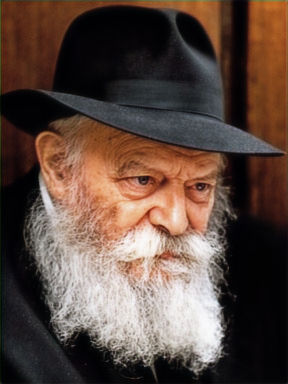
Grave of Rabbi Menachem Mendel Schneerson - Lubavitcher Rebbe
Rabbi Menachem Mendel Schneerson (April 18, 1902 – June 12, 1994), known universally throughout the Jewish world simply as the Rebbe, was the seventh Rosh (head) of the Chabad-Lubavitch Hasidic dynasty.
He is widely recognized as one of the most influential, dynamic, and revolutionary Jewish leaders of the 20th century. Taking the reins of a tiny Hasidic movement decimated by the Holocaust and Soviet oppression, the Rebbe transformed Chabad into a global empire of Jewish outreach, education, and social services. A unique blend of an elite Talmudic sage, an ordained secular scientist, and a master psychologist, his visionary leadership completely reshaped the face of modern global Jewry.
Early Life and Renaissance Education
Birth and Lineage: Born in Mykolaiv, Ukraine, his father was Rabbi Levi Yitzchak Schneerson, a renowned Kabbalist and Chief Rabbi of Yekaterinoslav (now Dnipro). He was named after his great-great-grandfather, the third Lubavitcher Rebbe (the Tzemach Tzedek).
Bridging Two Worlds: From childhood, he displayed a staggering, photographic memory for Talmudic and Kabbalistic texts. In 1928, he married Chaya Mushka Schneersohn, the daughter of the sixth Lubavitcher Rebbe, Rabbi Yosef Yitzchak Schneersohn (the Rayatz).
The Secular Universities: Unusually for a traditional Hasidic leader, he spent the late 1920s and 1930s pursuing advanced secular sciences in Western Europe. He studied mathematics, physics, and philosophy at the University of Berlin and later moved to Paris, graduating with a degree in electrical engineering from the École Spéciale des Travaux Publics (ESTP) and attending lectures at the Sorbonne.
Escape to America and Accepting the Mantle
In 1941, as Nazi forces closed in on France, the Rebbe and his wife miraculously escaped on one of the last passenger ships to leave Europe, arriving in New York on the 28th of Sivan (June 23, 1941).
His father-in-law, the Rayatz, immediately placed him in charge of Chabad’s central educational, social service, and publishing arms. When the Rayatz passed away in January 1950, the Hasidim begged the brilliant, intensely modest son-in-law to take over. After a year of fierce refusal, he officially accepted the mantle of leadership on the first anniversary of his father-in-law's passing (the 10th of Shevat, 1951).
The Chabad Outreach Revolution: Shluchim
While other post-war Hasidic masters focused primarily on rebuilding their insular communities in Brooklyn or Israel, the Rebbe looked out at a highly assimilated, spiritually fractured global Jewish populace and declared a historic counter-offensive.
The Army of Emissaries (Shluchim): The Rebbe pioneered the concept of the Shaliach (emissary). Instead of keeping his best and brightest disciples in the central study hall, he sent newly married young couples out to distant corners of the earth—from campus towns in America to remote areas in Asia, South America, and Europe. Their directive was simple: establish a Chabad House, welcome every single Jew without judgment, and revitalize Jewish identity through warmth, kosher food, and education.
The Mitzvah Campaigns: In 1967, around the time of the Six-Day War, the Rebbe launched his famous "Mitzvah Campaigns" (Mivtzoim). He sent his Hasidim onto city street corners with mobile "Mitzvah Tanks" to encourage passing Jewish men to wrap Tefillin (phylacteries), hand out Shabbat candles to women, and affix Mezuzahs on doors. He argued that a single, isolated good deed could structurally alter a person's cosmic spiritual destiny.
Sunday Dollars and Personal Counsel
The Rebbe operated on an astronomical schedule, routinely sleeping only a few hours a night and answering thousands of letters from across the globe every week.
Yechidut (Private Audiences): For decades, the Rebbe held private audiences all through the night, meeting with heads of state (including multiple Israeli Prime Ministers and American politicians), scientists, writers, and ordinary citizens seeking guidance on medical, personal, or spiritual crises.
The Sunday Dollar Line: In his later years, when individual private audiences became physically impossible due to the sheer volume of seekers, the Rebbe stood on his feet every single Sunday for hours, handing out crisp one-dollar bills to thousands of people from all backgrounds. The dollars were intended to be given to a charity of the recipient's choice, turning every visitor into an emissary of goodness.
Philosophy, Messianism, and Passing
The Rebbe’s teachings, captured in over 100 volumes of compiled discourses (such as Likkutei Sichos and Maamarim), brilliantly synthesized the highly rationalistic aspects of Talmudic law with the deepest, most abstract concepts of Jewish mysticism (Chassidus). He taught that the physical world is not an obstacle to spirituality, but rather a canvas waiting to be sanctified.
In the late 1980s and early 1990s, the Rebbe spoke extensively about the imminent arrival of the Messianic era (Mashiach), urging the world to prepare through increased acts of goodness and kindness. This triggered intense fervor among many disciples, some of whom openly identified the Rebbe himself as the long-awaited Messiah—a subject that generated significant discussion within the broader Orthodox community.
The Rebbe suffered a debilitating stroke in 1992 and passed away two years later, on June 12, 1994 (the 3rd of Tammuz, 5754), at the age of 92. He left behind no biological children, but left millions of spiritual heirs. He is buried at the Ohel in Queens, New York, which remains a 24/7 pilgrimage site for hundreds of thousands of people seeking blessings and inspiration.
Legacy
Defying the predictions of many sociologists who assumed the movement would fracture without a living leader, Chabad has expanded exponentially since 1994. Today, there are over 5,000 Chabad centersoperating in more than 100 countries. The Rebbe’s revolutionary blueprint successfully democratized Jewish mysticism, making traditional Torah life accessible, modern, and profoundly impactful on a global scale.