
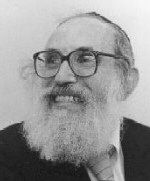
Grave of Rabbi Ahron Soloveichik
Rabbi Ahron Soloveichik (1917–2001) was one of the most brilliant and uniquely revered Talmudic analysts, legal authorities, and leaders of Orthodox Jewry in the 20th century.
As a premier scion of the legendary Brisker rabbinic dynasty, he was celebrated for his razor-sharp intellectual independence, his profound lectures on Maimonides, and an uncompromising, fierce moral conscience. Over his long career, he anchored major Torah institutions in both New York and Chicago, leaving an indelible imprint on American Orthodoxy.
1. Royal Brisker Lineage and the Escape to America
Born in Khislavichi, Russia, Rabbi Ahron was born into the absolute royalty of the rabbinic world:
His father was the legendary Rabbi Moshe Soloveichik.
His grandfather was Rabbi Chaim Soloveichik of Brisk (the "Brisker Rav"), the historic architect of the conceptual, analytical method of Talmud study that revolutionized yeshivas worldwide.
His older brother was Rabbi Joseph B. Soloveitchik (the "Rav"), the iconic leader of Yeshiva University.
In 1930, fleeing the brutal religious persecution of the Soviet Union, his family immigrated to New York City. Young Ahron studied under his father at the Rabbi Isaac Elchanan Theological Seminary (RIETS). Uniquely for Brisker scholars of his generation, he also pursued higher secular education, earning a Bachelor of Arts degree from Brooklyn College and later a Law Degree (LL.B.) from New York University Law School in 1946.
Though he never practiced corporate law, his legal education deeply sharpened his innate analytical approach to the societal and civil applications of Jewish law.
2. Master Educator: From New York to Chicago
After serving as a Rosh Yeshiva at Mesivtha Tifereth Jerusalem (alongside Rabbi Moshe Feinstein) and at Yeshiva University, Rabbi Ahron made a momentous move in 1966 to take the helm of the Hebrew Theological College (Skokie Yeshiva) in Chicago, Illinois.
The Founding of Brisk Chicago
In 1974, seeking to establish an institution completely dedicated to the hyper-rigorous, classic Brisker methodology without any external institutional compromises, he founded Yeshivas Brisk (the Brisk Rabbinical College) of Chicago.
Under his leadership, Brisk Chicago became the premier fortress of advanced Talmudic logic in the American Midwest, attracting elite students from across North America. Following the passing of his brother in 1993, Rabbi Ahron also began commuting weekly from Chicago to New York to deliver the prestigious senior lectures at Yeshiva University, maintaining a staggering schedule to ensure the continuity of his family's intellectual legacy.
3. The Uncompromising Moral Conscience
What set Rabbi Ahron apart from many of his contemporaries was his radical, fearless independence. He refused to align himself with any single political or religious faction, speaking out strictly based on his perception of absolute Torah truth and human dignity.
Champion of Civil Rights: During the height of the American Civil Rights Movement in the 1960s, Rabbi Ahron was one of the very few prominent Orthodox Rosh Yeshivas to publicly speak out against racial discrimination. He fiercely argued that racism was a fundamental violation of Kevod HaBriyot (human dignity) and the core scriptural truth that all mankind is created in the Divine Image (Tzelem Elokim).
Opposition to the Vietnam War: He took a highly controversial public stance opposing the Vietnam War on halachic grounds, questioning the moral and legal justification of the conflict under the Torah's strict laws governing warfare (Milchemet Reshut).
A Bridge Between Factions: Because of his towering lineage and pristine integrity, he was uniquely respected by both the Modern Orthodox world and the Charedi (Yeshivish/Chassidic) communities, frequently serving as a rare, trusted arbiter between disparate groups.
4. Personal Heroism: Triumph Over Illness
In 1983, Rabbi Ahron suffered a massive, near-fatal stroke that left him paralyzed on his left side, confined to a wheelchair, and in constant, agonizing physical pain.
His response to this catastrophe became the stuff of modern Jewish legend. Refusing to yield to physical limitation, he returned to his demanding schedule almost immediately. With superhuman willpower, he continued to travel, deliver multi-hour, highly complex Talmudic lectures, and stand—supported by students—for the reading of the Torah. For nearly twenty years, his daily life was a living sermon on the supremacy of the human soul over physical adversity.
5. Literary Legacy and Passing
Rabbi Ahron passed away on October 4, 2001 (17 Tishrei 5762) at the age of 84. In accordance with his wishes, his body was flown to Israel, and he was laid to rest on the Mount of Olives in Jerusalem.
His pristine legal formulations and ethical worldview are preserved in his definitive published works:
Parach Mateh Aharon: An exhaustive, highly celebrated multi-volume analytical commentary on Maimonides' Mishneh Torah.
Od Yisrael Yosef Beni Chai: A collection of his public addresses, legal responsa, and deep essays outlining his theological and social philosophies.
His children and grandchildren continue to serve as prominent rabbis, educators, and legal scholars across the global Jewish spectrum, extending the grand Soloveichik lineage into the 21st century.